Monday, 18 March 2024

Palm Sunday Vs Passion Sunday 2024 by Fr. Nelson Lobo OFM Cap

 WONDERING GURU

At The Procession with Palms – Mark 11:1-10 or John 12:12-16

(Isaiah 50:4-7; Psalm 22:8-9, 17-20, 23-24; Philippians 2:6-11c; Mark 14:1-15:47)
Worship on Palm & Passion Sunday: March 28th, 2021 | St. Matthew's Episcopal Church

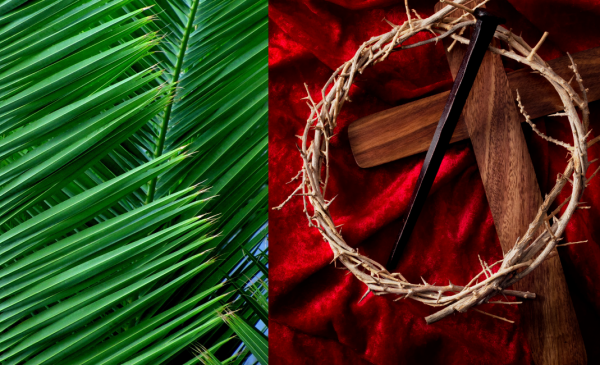
We get the name "Palm” Sunday because as Jesus rode into Jerusalem, the disciples laid down palm fronds on the road ahead of the donkey. Some translations refer to them as “leafy branches cut from the fields.” In the culture of their day, a king would ride into town on a horse if he wanted the people to know that he was ready for war and that he was their warrior king. However, when a king rode into town on a donkey, that symbolized the time of peace was at hand. Jesus chose a donkey to show that the time for peace and love had come. The people were awaiting the king, but most of them thought the king would be an earthly king that would readily protect Jerusalem from all enemies. Jesus, however, came as a king of peace.

Today’s Sunday is also known as “Passion Sunday.” Let’s explore the difference between the two: Palm Sunday vs Passion Sunday. “Palm Sunday” could refer to the events that fulfilled the prophecies of long ago. The prophecies that Zechariah foretold about the king who would ride into Jerusalem on a borrowed donkey and how the people went crazy with hope that they would be saved from the cruel Roman Empire.

But on the other hand, “Passion Sunday”, could tell a totally different story. This parade could refer to a funeral procession. This day marked the beginning of the end; the week of betrayal; and the week that would end in suffering and death. “Passion Sunday”, could refer to the stories of the last supper, and how Jesus shared with his disciples those things he wanted them to remember most.

When the Palm Sunday crowd saw Jesus riding into Jerusalem that day, they knew that something exciting was happening. They knew that Jesus was riding as the Messiah would, and they thought they knew what that meant. They thought it meant they would be free from the Romans, they thought it meant that Jesus was going to be their King. On the other hand, the Good Friday crowd turned against Jesus because he didn’t fulfill the dreams, they had of him the Sunday before.

This Palm Sunday Hosanna episode in the gospels seems a bit out of place because we know where Jesus is going. We know he is not going to Herod’s palace. We know he is not going to confront the Roman authorities. We know he is not going to topple the corruption of the temple leaders. We know he is marching through this city, going through this triumph, heading for a vicious cross. And we wonder, what do the words of triumph mean. What do their hosannas mean? Hosanna actually means save us. Imagine the Palm Sunday crowd saw this man as their king, and they thought he would save them in the way other great leaders had saved them. Looking to be saved from the oppression of a Roman occupation, from those in the temple who collaborated with the occupiers.

But Jesus wanted them to see the reality of who he was, not an earthly king, but a heavenly king. He was not a warrior who would come to destroy the Romans. Jesus was a warrior who would come to destroy sin and death.  Jesus was painting a picture of a suffering Messiah. A Messiah who would suffer for the sins of all the people. Dietrich Bonhoeffer wrote:  "God allows himself to be edged out of the world and on to the cross and that is the way, the only way, in which he can be with us and help us. Only a suffering God can help."  The crowds on that first Palm Sunday wanted a Warrior King, but Jesus came as a suffering Messiah. Jesus came as one who would die on a cross for the sake of human kind.

Palm Sundays/ Celebrations in our life teach us nothing but we learn great wisdom and life’s lessons on Passion Sundays/Sufferings.

Thursday, 14 March 2024

Daring Discipleship in the New Covenant by Fr Nelson Lobo OFM Cap


WONDERING GURU

Fifth Sunday of Lent, 17th March 2024

Jeremiah 31: 31-34; Psalms 51: 3-4, 12-15; Hebrews 5: 7-9; John 12: 20-33


Fr. Nelson Lobo OFM Cap


The Difference between the Old & the New Covenant: - The words "New Covenant" indicates that Jeremiah is comparing two different covenants through which God established a relationship with his people. If God is going to make a new covenant, that means there was an old one. The first reading tells us that if the people, observed his laws and observed his commands, he would bless them. But if they failed to live as his law instructed, they would suffer. Yet before the ink was dry on the old covenant, they had already broken it by engaging in all sorts of pagan immorality. They had forgotten what God had done for them. Now let us fast-forward several hundred years to the sixth century B.C., When Jeremiah served the little nation of Judah, the remaining fragment of God's Covenant. Now Jeremiah's book is filled with doom and gloom and warnings to the tribe of Judah, because the people had forsaken God. They had forsaken him time and time again. Finally, God gave them a seventy-year "time out".  He allowed an enemy nation to attack, defeat, and deport them from their homeland for seven decades. That was the historical backdrop about today’s first reading.

We the people have continued in that sinful tradition. In reality, this game show has been played over and over in God's word, beginning in the Garden of Eden. God had given Adam the sweetest deal. Free run of the Garden, a beautiful wife, peace, no war, no famine, no poverty, no hate, and an intimate personal relationship with the creator of the universe. Then Satan came along (Genesis 3) tempting Eve with a new deal. One that he portrays as a better Deal. Satan basically says to Eve that if she takes his deal she will be like God.  There is an old saying "Opportunity knocks once but temptation beats on the door every day."  We are constantly being tempted to take a bad deal. 

What does God's "New deal" or the New covenant offers us?

 "'This is the covenant I will make with the house of Israel after that time,' declares the Lord. 'I will put my law in their minds and write it on their hearts. I will be their God, and they will be my people, 'For I will forgive their wickedness and will remember their sins no more.'"  This New Covenant was no longer only to the Old Testament people but also for the New Testament people as well. The new covenant relationship with God is not based on what people do. It is based on God, on Jesus Christ.  The promised Messiah brought this new covenant relationship to fruition by his sacrifice: "I will forgive their wickedness and will remember their sins no more." (Jer 31:34; Heb 8:12). Iniquity against God pardoned for the sake of his Son. He will separate our Sins as far as the East is from the West and He will cast them into the depths of the sea (Psalm 103:12; Micah 7:19). This is the New Covenant, a covenant of Grace. A New Covenant based on faith, not obedience to a law. Through this New Covenant we are set free from the bondage of sin no longer slaves but children of God.

Daring Discipleship: We live in a world where heavenly things confuse our earthly minds. Jesus tells us that our very usefulness or our fruitfulness for God is tied to our willingness to surrender our lives even to die for Him. There are about six instances where Jesus mentions bearing fruit as a Christian - and five of those are tied to the cross or dying. In Short - it is in dying and not in doing that we bear fruit for God. Some examples of biblical contradictions that human mind finds hard to understand.

We see unseen things (2 Cor. 4:18); We conquer by yielding (Rom. 6:16-18); We find rest under a yoke (Mt. 11:28-30); We reign by serving (Mark 10:42-44); We are made great by becoming little (Luke 9:48); We are exalted by being humble (Mt. 23:12); We become wise by being fools for Christ’s sake (1 Cor. 1:20, 21); We are made free by becoming His bond servants (Rom. 6:10); We wax strong by being weak (2 Cor. 12:10); We triumph by defeat (2 Cor. 12:7-9); We find victory by glorying in our infirmities (2 Cor. 12:5); We live by dying (John 12:24, 25; 2 Cor. 4:10,11)

Conclusion: Jesus is looking for people who will follow Him with a reckless abandon. He wants people who will throw caution to the wind and embark on the journey called discipleship. Jesus is searching for a few daring hearts who will fully devote themselves to Him. Jesus is searching for people who will give their lives for Him. Jesus is looking for people just like you and me. The only question that remains is this: will you join the journey? Will you take up the call Jesus issues: Come, follow me? Will you dare to be a disciple?  Discipleship is not for sissies.


“When Christ calls someone; He bids them to come and die”.

(Dietrich Bonhoeffer- German theologian)


Thursday, 7 March 2024

The Story of the Greatest Gift of Love & Life by Fr. Nelson Lobo OFM Cap

 WONDERING GURU

Fourth Sunday of Lent—Year B – 10th March 2024


(2 Chronicles 36: 14-16, 19-23; Psalm 137: 1-6; Eph 2: 4-10; John 3: 14-21)

Fr. Nelson Lobo OFM Cap

Introduction: How can we explain the meaning of Christmas in just a few words? Well, the best way I know is found in today’s Gospel: "For God so loved the world that he gave his only begotten Son, that whosoever believeth in him should not perish, but have everlasting life." Many scholars agree that John 3:16 is the Gospel in a nutshell. John 3:16 tells us the Story of the Greatest Gift of Love & Life.

1. The Greatest Love – God so loved the world. It’s truly so amazing that God chooses to love each one of us humans when He has the whole galaxy to love. He loves us even though we are sinners. He even loves those who don’t believe He exists. That is hard to believe, but He does. He doesn’t love their sins, but He loves the person. Every person in the world can be assured of His love. This is the greatness of our God.  The unconditional love of God encompasses the whole universe.

2. The Greatest Gift –He sacrificed His One and Only Son for us.

I don’t know why our life is so important to God that He allowed His son to go to the Cross for our sins. Parents say the love you have for your children is so great and profound that it could never be put into words. Losing a child to death is so horribly difficult to accept. It’s a nightmare for parents.  Knowing those two feelings, and knowing that God chose to allow His Son, His perfect blameless Son to die for us still dumbfounds me every time I think about it. May be this illustration could help us to understand this gift. A gem dealer was strolling the aisles at the Tucson Gem and Mineral Show when he noticed a blue-violet stone the size and shape of a potato. He looked it over, then, as calmly as possible, asked the vendor, "You want $15 for this?" The seller, realizing the rock wasn’t as pretty as others in the bin, lowered the price to $10. The stone has since been certified as a 1,905-carat natural star sapphire, about 800 carats larger than the largest stone of its kind. It was appraised at $2.28 million.  It took a lover of stones to recognize the sapphire’s worth. It took God the Lover of His people to recognize the true value of ordinary-looking people like us.

3. The Greatest Life – Everlasting life. Life with Jesus is greater than any other life there is. People run after pleasure: drinking, smoking, eating, sleeping around and they call it the “good times” of life. After a while people get fed up and call such experiences empty or nothing. King Solomon called such life as vanity of vanities.  St. Augustine after experiencing such emptiness uttered “our hearts were made for you Lord; they are restless until they rest in you”.

Back in 1830 George Wilson was convicted of robbing the U.S. Mail and was sentenced to be hanged. President Andrew Jackson issued a pardon for Wilson, but he refused to accept it. The matter went to Chief Justice Marshall, who concluded that Wilson would have to be executed. "A pardon is a slip of paper," wrote Marshall, "the value of which is determined by the acceptance of the person to be pardoned. If it is refused, it is no pardon. George Wilson must be hanged."

2,000 years ago, God the Son – Jesus the Christ issues a pardon but just like in the case of George Wilson the value of the pardon is determined by the acceptance of the person to be pardoned.  If it is refused, it is no pardon. We don’t have to accept the life Christ offers us. We can refuse. His offer is of eternal life. But he who refuses to accept this gift knowing full well that life on earth is temporary is a fool.

Conclusion: God’s Love is a story of the Greatest Gift of love and Life. All we have to do is accept it. The Love is free. The Gift is free. The choice is us to make. Let’s make the right choice with the grace of God. Amen


Thursday, 29 February 2024

YOU ARE THE TEMPLE OF THE HOLY SPIRIT by Fr Nelson Lobo OFM Cap


WONDERING GURU

3rd March 2024, Third Sunday of Lent, Year B

Who/What is desecrating your temple?

Exodus 20:1-17 Or 20:1-3, 7-8, 12-17; 1 Corinthians 1:22-25; John 2:13-25


Fr. Nelson Lobo OFM Cap


I. Passover in the Temple: The Passover of the Jews was near, and Jesus went up to Jerusalem. The Passover was the annual commemoration of the great deliverance of the people from the land of slavery (Ex. 12). A one-year-old male lamb without blemish was killed in the afternoon. That evening a detailed family celebration took place. Many oxen and sheep were offered up in sacrifice to God as the Festival of Unleavened Bread continued for seven more day (Ezek. 45:21). The temple area was always crowded during Passover with thousands of out-of-town pilgrims. The religious leaders crowded it even further by allowing money changers and merchants to set up booths in the court of the Gentiles. The temple tax had to be paid in local currency, so foreigners had to have their money ex-changed. The money changers often would charge exorbitant rates with commissions. The people were required to make substitutionary sacrifices as offerings for their sins. Because of the long journey, many could not bring animals. Some who brought animals would have them rejected for imperfections. So, animal merchants had a thriving business, a business they moved into the temple court yard. It was profitable to the sellers, and no doubt to the priests. And so, being convenient for all and profitable to many, the thing became a recognized institution. But the religious leaders did not seem to care that the court of the Gentiles was so full of merchants that people found it difficult to worship. And worship was the main purpose for visiting the temple.

II. Purifying the Temple: The temple was firmly established, and at the centre of Jewish religious life. The people believed that the temple was the place where God in heaven met people on earth. It was a symbol of God’s relationship with His people, and it served as a constant reminder of God’s claim upon their lives.  The temple took 46 years to build, and tradition surrounded it stretched back to the reigns of King David and his son, King Solomon.   But something was desperately wrong. It had become something other than what God intended it to be.  It had become corrupt!  Therefore, we see that Jesus attacks the root of all evil, money (I Timothy 6:10). God’s temple was being misused by people who had turned it into a marketplace. They had forgotten, or didn’t care, that God’s house is a place of worship, not a business nor a place for making a profit. Many commentators see this as the fulfilment of Mal. 3:1ff. God’s promised purification of His temple. Jesus made a whip (of rope or reeds) and chased out the money changers.  It was the first public appearance of Jesus before His nation as Messiah. He inaugurates His work by a cleansing and a claim. He cleansed the temple of distractors and distractions and claimed it His right by an act of authority that indicated Him to be the King of Israel and the Lord of the Temple.

III. Passion for the Temple: His disciples remembered that it was written, “Zeal for Your house will consume me.” The effect of Jesus’ courageous zeal on the disciples was to remind them of Ps. 69:9. The action of Jesus revealed the inward passion He had for God. It gave evidence of a consuming zeal for the house of God and ancient Scriptures found their fulfilment in what He did.  Jesus exercised His right as the only begotten Son of God. He took the oppressive, disruptive, evil dealings in the temple as an insult against God, and thus He did not deal with it half-heartedly. He was consumed with righteous anger against such flagrant disrespect for God’s place of worship.

CONCLUSION:  The cleansing of the temple in Jerusalem, is a picture of Christ entering into the human body and cleansing the soul so the body can become a temple of Christ.  The first great cleansing in our lives is to attack the root of all evil, money (I Timothy 6:10).  The real temple, the real place God wants to live, the real place of worship and prayer is the human heart. If Jesus took such zeal to cleanse a temporary earthly temple, imagine the zeal He experiences in giving God a proper place of worship in your life. He has a passion that your heart not be clutter with the world but be set aside as a place of prayer and worship. You see when Christ comes into the temple there can be no other gods. When Christ comes into the temple it is to be a place of prayer, of communion with God the Father. That and that alone is to be the priority and the purpose. So, when Christ comes into my temple – into my life – he comes to cleanse. He comes to cleanse me of my sin. He comes to cleanse me of personal ambition, passions and gods that take me away from God my father. He comes to overturn and drive out my money tables, all the places where I exchange the things of God for the lesser things of this world.

Jesus drove out those who desecrated the Temple. You are the temple of the Holy Spirit-Who is desecrating your temple? What tables in your temple need overturned and cleansed? Remember the purpose of cleansing – to bring healing and restoration. When Christ comes into my life to cleanse it is to restore me to wholeness of life. It is not just to overturn tables – it has a purpose to make my temple/life a place of prayer and communion with the Father. Will I be like the religious leaders annoyed and offended at Christ’s cleansing?


“If Christ showed such zeal in cleansing an earthly temple, He will use zeal in cleansing another temple, the believer’s life, also”.

Wednesday, 21 February 2024

TRANSFIGURATION=WHO IS JESUS? (The Identity of Jesus in the Bible) Fr. Nelson Lobo OFM Cap


WONDERING GURU

Genesis 22: 1-2, 9a, 10-13, 15-18; Psalm 116; Romans 8: 31b-34; Mark 9: 2-10


World: Who is Jesus?

Bible: He is the Son of God (Mt 3: 17; Jn 3:16-17; Mk 9: 7; Gal 2:20).


World: Who is Jesus?

Bible: He is the one seated at the right hand of the throne of God (Heb 12:2).


World: Who is Jesus?

Bible: He was the Word from the beginning and the Word was with God, and the Word was God & the Word became flesh (Jn 1:1-14).


World: Who is Jesus?

Bible: He is the mediator between God and men (1 Tim 2:5).


World: Who is Jesus?

Bible: He is one with the Father (John 10:30-33).


World: Who is Jesus?

Bible: He is the propitiation for the sins of the whole world. (1 John 2:2)


World: Who is Jesus?

Bible: He is the Alpha and the Omega, the first and the last, the beginning and the end.”  (Rev 22:13)


World: Who is Jesus?

Bible: He is the same yesterday and today and forever (Heb 13:8).


World: Who is Jesus?

Bible: This Jesus is the cornerstone. We are saved in His name (Acts 4:11-12).


World: Who is Jesus?

Bible: He is the way, the truth, and the life (Jn 14:6).


World: Who is Jesus?

Bible: He was before Abraham (Jn 8:58).


World: Who is Jesus?

Bible: He is the Light of the world (Jn 8:12).


World: Who is Jesus?

Bible:  He is Immanuel- God with us (Is 7:14).


World: Who is Jesus?

Bible: He is the Lord of lords and the King of kings (Rev 17:14; Philip 2:8-11).


World: Who is Jesus?

Bible: Wonderful Counselor, Mighty God, Everlasting Father, Prince of Peace (Is 9:6).


World: Who is Jesus?

Bible: He is our Lord and salvation.  (Acts 4:12; Rom 10:9).


World: Who is Jesus?

Bible: He is our healer. (1 Pet 2:24). 


World: Who is Jesus?

Bible: He is The Son of the living God (Mt 16:15-16).


World: Who is Jesus?

Bible: He is the resurrection and the life (Jn 11:25).


World: Who is Jesus?

Bible: He is the one who holds all authority in heaven and on earth (Mt 28:18).


Does anyone need any more proof about the identity of Jesus?


Thursday, 15 February 2024

The Three Temptations by Fr. Nelson Lobo OFM Cap


WONDERING GURU


Genesis 9: 8-15; 1 Peter 3: 18-22; Mark 1:12-15

Fr. Nelson Lobo OFM Cap

1.    What is Temptation?

Temptation means to be enticed, incited or attracted to do something wrong or a forbidden thing. A recent survey of Discipleship Journal readers ranked areas of greatest spiritual challenge to them: 1. Materialism 2. Pride 3. Self-centeredness 4. Laziness 5. Anger/Bitterness 6. Envy 7. Gluttony 8. Lying. Survey respondents noted temptations were more potent when they had neglected their time with God (81%) and when they were physically tired (57%). Resisting temptation was accomplished by prayer (84%), avoiding compromising situations (76%), Bible study (66%), and being accountable to someone (52%).

2.    Where do Temptations come from?

1. The source of temptations can be many. By one’s own lusts, desires, passions or selfish interests. (James 4:1-4) by the lusts of the flesh, eyes and by the boastful pride. (I John 2:15,16). From our own sinful human nature.

2. God may give Satan permission to tempt some of us like in the case of Job. (Job 1:12). Satan may tempt anyone as he did Jesus with offers of power, prestige and positions. (Matt. 4:1-11)

3. Everyone can be tempted by bad associates or friends (Prov. 1:10). Some Christians can be tempted by well-meaning people. Temptations can come from all kinds of worries, riches or pleasures of this life.

4. Frustrations, sickness, poverty, difficulties or discouragements can tempt us to give into feelings of defeat, despair and failure. Bitterness can cause us to grow resentful towards people, organizations or even our own poor choices. Temptations can come from many types of worries, riches and pleasures

5. Temptations can come from accomplishments, accolades or worldly thinking.

3. Why does God allow us to be Tempted?

God can use temptations to develop more of a Godly character in us. To test the level of our spiritual maturity and obedience. To provide examples to others how they can overcome obstacles. Remember human heart is the battlefield between God and Satan.  Where God rules with love but Satan rules with lies and cunningness.

4.    What are some different types of Temptations?

We can be tempted by anything that appeals to our human desires that are contrary to the will of God. These temptations can come in the form of unbelief, mis-beliefs, worry, jealousy, anger, wrath, slander, clamour, immorality, laziness, drunkenness, complacency, selfishness, idolatry, selfish ambition, false securities, societal pressures, family pressures, peer pressures, sexual allurements, the love of money, possessions, unbelief, immaturity, failure to grow up in all aspects into Christ, unhealthy comparisons, sins of omission, sins of commission, sins of disposition, sins of wrong assumptions. (Gal. 5:19-21)

5.    What are some of the results if you yield to Temptations?

If you give into any temptation, it will eventually become your Master. Obsessions of pride, relationships or personal interests. Giving into temptations can ruin your credibility and disqualifies you from being an example. Giving into temptations disqualifies you from being promoted to higher levels of responsibility.

6.    How some of us deal with Temptation?

We generally deal with temptation in 1 of 3 ways:

a. Some people simply give in to it. Their philosophy says, "Don’t worry about temptation. If it feels good, do it. Whatever is natural must be right." So, they exist like animals, living for their own self-gratification. This could be the side effect of believing in the theory of evolution.

b. Some fight temptation with their own strength. They fight and fail, fight again and fail again because no one can overcome temptation consistently in his own strength. If we could, Jesus would not have had to come and die for us. These people might hate what they do, but they go on doing it because they do not have the power to stop themselves.  E.g. Judas

c. Finally, there are those who overcome temptation through the power of the Lord Jesus Christ. God’s grace is sufficient for us.

7.    How to overcome Temptations?

Let the word of Christ dwell in you richly, teaching and admonishing one another with psalms and hymns and spiritual songs. Singing and making melody in your hearts. Whatever you do in word or deed do all in the name of the Lord Jesus. (Col. 3:16). Watch and pray that you do not enter into temptations. The spirit is willing but the flesh is weak. (Mat. 26:41). Fix your thoughts on things above and not on things of the earth. Wisely choose your friends and close associates. Draw near to the Lord through morning devotions before you do anything else. Follow the faith and the lifestyle of Godly people. Remind yourself of all the promises of God. Have the joy of the Lord as your strength Expect great things from God attempt great things for God. Commit yourself to Christ, His church and the fulfilling of His great commission.

Conclusion- No temptation that comes to you is beyond your capacity to resist it. In fact, temptations are universally appealing to all people, just in different forms. But God monitors the level of the intensity of each temptation so that we are able to bear up under its pressures. (I Cor. 10:13)

 ---------------------------------------------------------------------


Friday, 9 February 2024

SEE WHAT JESUS SAW, DO WHAT HE DID by Fr. Nelson Lobo OFM Cap


WONDERING GURU

11th February 2024

6th Sunday in Ordinary Time

(Our Lady of Lourdes-World Day of the Sick)

Lev 13: 1-2, 44-46 ;1 Cor 10: 31-11:1; Mk 1:40-45


 Introduction: What type of feeling do we experience when we hear horrible news. The New Testament has a Greek word for that feeling; it is “Splagchna.” It literally means bowels or guts, but it is translated “Compassion.” The only person that this word is associated with is Jesus. It says that Jesus felt this way when He encountered the sick (Mt 14:14), the blind (Mt 20:34), the demon possessed (Mk 9:22), those who lost loved ones (Lk 7:13), the hungry (Mt 15:32) the lonely (Mk 1:41) and the bewildered (Mt 9:36). Our word “Compassion” comes from two Latin words (com & pati); literally means “suffering with” others. Latin compassio is an ecclesiastical translation of Greek sympatheia

HOW TO CULTIVATE COMPASSION?

1)    See People with Jesus’ Eyes (see what He saw)-Mat 9:36- When he saw the crowds, he had compassion on them, because they were harassed and helpless, like sheep without a shepherd. 1 Sam 16:7 “The lord does not look at the things man looks at. Man looks at the outward appearance, but the Lord looks at the heart.”

2)    Touch the hurting people (feel what He felt)- Mark 1:40-42-The amazing part of this healing is how Jesus did it - Jesus TOUCHED him! Even if he had not been healed physically, this would have begun to heal him emotionally.  Physically leprosy patients don’t feel pain, but they suffer as much as anyone. Almost all the pain they feel comes from the outside, the pain of rejection imposed on them by their own community. They are rejected because they are contagious. Their body is rotting. They stink. They are deformed. So, they are forced to live outside the community. They must keep a six-foot distance from anyone – even their spouse and children. They knew great loneliness. Mother Teresa has said, “We have drugs for people with diseases like leprosy. But these drugs do not treat the main problem, the disease of being unwanted. That’s what my sisters hope to provide. The sick and poor suffer even more from rejection than material want. Loneliness and the feeling of being unwanted is the most terrible poverty.”

3)    Serve Jesus by Serving those in Need (do what He did)-Mat 25:40 “I tell you the truth, whatever you did for one of the least of these brothers of mine, you did for me.’”  Consider the leper fully covered in leprosy. His body rotting, numb and incurable. Yet this leper’s scars ran far deeper than his debilitating disease. Suffered from the scars of a lost identity. (Now just a leper). Suffered from the scars of a destroyed dignity. (torn clothes). Suffered from the scars of repulsion. (All he touched was defiled). Suffered from the scars of isolation. (No home).

Conclusion: Jesus is not afraid to touch our scars. On some level we all can relate to the pain they have experienced. We too have been victims of the cruelty of mankind.  Our hearts can become leprous as this man. When our inner scars eat away at us. When our inner scars leave us numb and unfeeling. When our inner scars make us someone we’re not. When our inner scars push us to isolation.  We all need the touch of Jesus to heal us. Jesus wants to heal the hurts that others could never heal. Maybe it’s the scars of old wound that you never got over. Maybe it’s the scars of insecurity with roots in your childhood. Maybe it’s the scars of past sins that you can’t seem to forgive yourself for. Maybe it’s the scars of sin that you never dealt with.  Let’s go to Jesus for our healing and be wholesome once again.  Jesus loves us. He feels compassion towards us. He wants to heal us and make us whole. Amen!


Baptism of the Lord by Fr Nelson Lobo OFM Cap

  WONDERING GURU Isaiah 42: 1-4, 6-7 or (40: 1-5, 9-11);  Psalm 104: 1b-2, 3-4, 24-30 Titus 2: 11-14; 3: 4-7;  Luke 3: 15-16, 21-22   ...