Friday, 26 January 2024

Dealing with the “Spiritual Terrorists” in the church by Fr. Nelson Lobo OFM Cap


WONDERING GURU


Deut 18: 15-20; 1 Cor 7: 32-35; Mark 1: 21-28


 Intro: In today’s gospel we read about a great move of God that took place in the city of Capernaum. This took place at the beginning of the second year of our Lord’s ministry - what scholars commonly refer to as the “Year of Popularity.” Year one of His ministry was a “Year of Obscurity” and year three was the “Year of Rejection,” but year two was the year when Jesus became popular with the people, and this awakening in Capernaum was the beginning of that popularity. Jesus obviously spoke with authority that the scribes often seemed to lack in their teaching. They (the scribes) obviously had what someone has labelled as "positional authority" that seemed to lack in its ability to satisfy spiritual hunger. "Positional authority without spiritual power leaves churches suffering. It also leaves hurting people unchanged in a world where people need to be healed" .

What happens when Jesus takes over?

1. Satan’s kingdom is shaken up- We are told that Jesus taught with authority. Declaring God’s truth without compromise stirred up the kingdom of Satan. Imagine what was going on in Capernaum. Jesus is speaking and acting with divine authority. This, no doubt, got the demons in the city of Capernaum upset. They had people whose lives were given over to sin and immorality people enslaved to alcohol and drugs; marriages falling apart; children disrespecting their parents…Yes, they had things under control . . . Until Jesus started taking over Capernaum. When Jesus takes over, Satan’s kingdom is shaken up.

2. Sinners are freed - The Bible tells us that before the day was over, “the whole town gathered” to Jesus. This is something that always happens when Jesus takes over.  Now, we are called to be like Christ in this world. And the key to that is allowing the Lord Jesus, who dwells within us through the person of the Holy Spirit, to live His life through us. In other words, if Jesus is going to be free to take over, he must first be allowed to take over in the lives of His people. God’s people must straighten up! During the Welsh revival, Evan Roberts preached a sermon time and again that God used to challenge His people in Wales to “straighten up.” It was called “The four points.”

1. You must put away any unconfessed sin.

2. You must put away any doubtful habit.

3. You must obey the Spirit promptly.

4. You must confess Christ openly.

If we really want to see Jesus take over, we must determine who we are and whose we are! Are you a Child of God or a child of the world? Do you belong to the Lord or to the world?

3) “Spiritual Terrorism” encountered-This ministry modelled after Jesus’ preaching, teaching, and prophesizing also has to confront the ugliness of its opposition. Strangely, the ugliness or “spiritual terrorism” is not always found outside but it’s found within the church. There is a spiritual war going on that exists to hinder the work of God. We have our own unclean spirits working to divide the church. The “Spiritual Terrorists” who destroy God’s ministry are those who are always arguing, fighting, gossiping and complaining.

The word Mark uses here for ‘unclean’ implies a “desire to be filthy”. To be unclean means to have a desire for filth over that which is holy. Any time we choose to do the wrong thing rather than choose that which is right we desire filth. The good news is that we serve a Jesus who likes to get up close and personal and have direct contact with those people and places that seem unclean. Jesus sought to make the filthy fit for the kingdom. He sought to make the dirty a declaration of God’s love and kindness. Jesus was God’s detergent for a dirty humanity. He reached into the places that other agents could not and would not go. He would reach people that the prophets couldn’t get to, the priests couldn’t get to, and the kings couldn’t get to. And that is what he is calling the church today to do. We are to be the cleansing agents for a filthy world. He wants us to reach those who others will not touch because the world has deemed them unclean.

 "I am far within the mark when I say that all armies that ever marched, and all the navies that were ever built, and all the parliaments that ever sat, and all the kings that ever reigned, put together, have not affected the life of mankind on this earth as powerfully as that One Solitary Life". (Massey Mott Heltzel. The Invincible Christ. Nashville: Abingdon Press).

This statement tells us about the ageless authority of Jesus Christ our Lord and Savior. Jesus Christ is Lord of all! Others may have authority and power. Only Jesus has the power to save people from their wages of their sin which is death (Romans 6:23). The authority of others is limited by time and boundaries as their authority will one day come to an end. But, the authority of Jesus never ends!

No king or kingdom, ruler or dictator, government, organization or individual can ever give us eternal life! No one else has conquered sin, death and the fear of death! God only gave this authority to Jesus Christ! We are powerless and hopeless without Jesus Christ as our Lord and Savior! That is why without Jesus we can do nothing (John 15:5)!

Benjamin Franklin once said that "God helps those who help themselves". But, the truth of the matter is that without Jesus we would be helpless and hopeless.  When we as Christians pray we almost always end our prayers saying, "… in Jesus’ name. Amen." We do that because we know that Jesus is the name of our Savior who saves us from the power of sin. We also do that because we know that His strength is made perfect in our weakness (2 Corinthians 12:9). God’s grace through Jesus Christ is all that we need: "My grace is sufficient for you, for my power is made perfect in weakness."


👉28th January 2024, 4th Sunday in ordinary Time, Year B


Thursday, 18 January 2024

Jonah The Reluctant Prophet by Fr. Nelson Lobo OFM Cap


WONDERING GURU

Jonah 3:1-5,10; 1 Cor 7: 29-31; Mark 1: 14-20

Fr. Nelson Lobo OFM Cap


Introduction: The book of Jonah is a short book, 4 chapters. Some believe the story is allegorical or a metaphor for the disobedience of the Israelites and the salvation of the Gentiles. But Jonah is documented as a historical figure in 2 Kings and he his mentioned in several ancient Jewish histories. The major point that divides the scholars seems to hinge on the supernatural: some cannot accept the supernatural element of the story, a great fish swallowing a man. Nineveh during that time in history was extremely important. It was a commercial. The city was very large. People from all over the world came there to make money. But the city had spiritual problems. No one knew the true God. They thought they did. Nineveh thought everything was alright. But then Jonah told them, “40 more days and Nineveh will be destroyed.” God had enough. He was going to wipe these people off the face of the earth, just as he had done to Sodom and Gomorrah. The people of Nineveh repented. They declared a fast. They stopped their pattern of sinning. They looked to God for forgiveness. To repent means to stop being fake. When God saw what they did and how they turned from their evil ways, he had compassion and did not bring upon them the destruction he had threatened.”

Character of Jonah: Jonah was running away from the Lord. He didn’t want to carry what the Lord had given him. How often do we behave like Jonah? And where does this disobedience lead us? Jonah had been running away from the Lord, but the Lord had not been running from him. So at the beginning of chapter 3 the same word from God came to him a second time saying: “Go to the great city Ninevah and proclaim to it the message I give you.” This time, Jonah obeyed the Word of the Lord, but with very little enthusiasm.

Why was Jonah such a reluctant disciple? Well, Jonah is a good example of the disobedience to God that Israel often displayed. Good Jewish prophets didn’t preach to other nations! Jonah didn’t want the city of Nineveh to be saved! He believed that there should be a strict separation between Israel and other peoples but obviously God felt otherwise. Jonah knew this in his heart and thus he was trying to thwart God’s will. Do we ever try to thwart God’s will due to any kind of prejudice we might have? Well, The Book of Jonah makes it clear that God is concerned for the salvation of all people and as His disciples we are called to take God’s message to some places where we might not want to go.

Another reason that Jonah didn’t want to carry out God’s call was because he was afraid of the Ninevites. Nineveh was the capital of Assyria, a nation known for dread and terror! But amazingly, Jonah’s sermon was a huge success! The people of Nineveh accepted his message, they believed it, they repented they were saved!

Now our dear friend Jonah should have been pleased by the outcome. He should have been glad to know that he had carried the message, which the people had listened to and they were now children of God.  His preaching has brought redemption and forgiveness. Not the total destruction of the entire city. Jonah wants Nineveh destroyed. Our poor disgruntled prophet is having a rough time. So, he climbs up to a hilltop to wait and see what will happen. God, our ever-kind Father, makes a vine grow so our unhappy camper will have shade from the burning sun. Jonah is very happy for this. But the next morning when the vine dies our dear friend is furious that the vine died. God then speaks to Jonah. He says these words that must have made Jonah feel the smallest of the small, “You have been concerned about this vine, though you did not tend it or make it grow. It sprang up overnight and died overnight. But Nineveh has more than a hundred and twenty thousand people who cannot tell their right hand from their left, and many cattle as well. Should I not be concerned about that great city?” We do not know how Jonah responded nor do we know how he must have felt. But how do we feel when we disobey and disappoint? Through this story of conversion, God reveals again, that God is a God Who cares even if we don’t. Jonah certainly didn’t care about Nineveh he was even angry that God saved them!

Question: When’s the last time you honestly asked God to reveal His will for your life? When was the last time you went to God’s Word seeking to obediently follow His desire and direction? What have been the consequences of doing things your own way instead of God’s way? Jonah is what many of us are at certain points in our lives: stubborn, disobedient and prideful. When Jesus called Simon and Andrew and James and John to follow him, He was calling them to also immediately leave behind some things and some people that were very near and dear to them for a long time. What do we need to leave behind in immediate obedience to God?

The disciples were not like Jonah at all. They were ready to serve Christ. They were ready to follow Him. They felt the authority, the power of this man and they followed. None of them tried to turn and run away. They accepted and they followed. How many of us would just follow the Lord wherever He leads us? 


👉3rd Sunday in Ordinary Time-Year B-21st January 2024

Tuesday, 9 January 2024

Would you be an Andrew for Jesus? by Fr. Nelson Lobo OFM Cap


WONDERING GURU

1 Sam 3: 3-10,19; 1Cor 6:13-15, 17-20; John 1:35-42


Fr. Nelson Lobo OFM Cap


Intro-The story of Edward Kimball. Many of us have never heard of Edward Kimball, a Sunday school teacher. He won a young fellow to the Lord, he was a Boston shoe salesman, and got that shoe salesman so on fire that he became the well-known evangelist Dwight L. Moody.

Understanding Andrew as the Seeker of Truth- In John 1:35-42 we are first introduced to Andrew. Andrew was a disciple of John the Baptist. Andrew was baptized of John. He was a seeker after the truth. He found the truth in John the Baptist and followed him. John would always mention that he was not the Messiah but someone else. When John the Baptist pointed out Jesus as the Lamb of God who would take away the sins of the world, Andrew knew that this man was the Messiah prophesied of Old. Andrew, unlike a number of the disciples of John the Baptist, followed Christ and forsook John. If the truth be known this is what John the Baptist wanted. Men to follow Christ. Jesus accepted these two and let them dwell with him for a time. They saw him and talked with him and noticed what he did. Being the tenth hour, they probably spent the night with Jesus. After this, Andrew was convinced that Jesus was the Lamb of God. Andrew found joy and peace. He immediately began to tell others. Andrew was one of the first to recognize Jesus as the Promised One, and this will never be taken from him.  Andrew had found a great treasure and he wanted to share it with others. Andrew did not sit around after this and ask, “What am I to do?” He knew what he was to do, and that was to tell others and lead others to Jesus Christ.

Understanding his family ties- Andrew was totally convinced that Jesus was the Messiah. Andrew goes and the first one he tells is the one who he is closest to, his brother Simon. Andrew worked with Simon as a fisherman. Andrew probably was the younger of the two. Family is the most difficult place to witness, but the first place that Andrew went. Andrew used his influence on his family. Simon makes a decision based on Andrew. Simon must have had a lot of respect for Andrew. Simon probably was not as religious or such a zealous follower of the truth as his brother, and so Simon trusted his brother’s judgement.

Understanding his nature- (John 6:5-13) The disciples were filled with despair. Andrew looked beyond this and saw the possibilities. Andrew spoke with this little boy. Spent time with him. Andrew was concerned about the little people. Andrew was the best person to bring this boy. Andrew was humble. Different from many of the disciples. Andrew did not have outstanding gifts, like Peter or Judas or John and James. Many times Andrew was left behind. He used what he had, not much, but he used what he had. Andrew knew in his own life that little is much when God is in it.

Understanding his personality-(John 12:20-23) Andrew was approachable, kind, thoughtful, sincere, bent on bringing others to Christ. Andrew distinguished himself among the disciples for these things and so Philip trusted his judgement. The disciples came to him for help. Andrew may have been the counsellor, or the listener of the group. Because of this Philip brought the Greeks to him and both Philip and Andrew went to Jesus. Andrew did not do anything that outstanding or glorious. Andrew might have become frustrated with his brother and the others when they argued about who was the greatest. Andrew was not scared to have second place. As a matter of fact, he was comfortable with second place. He really didn’t care about such things. The Bible tells us that love does not envy, and this is definitely what Andrew did. He did not envy even his own brother. Andrew never wrote a book, he never spoke up or out of turn, as a matter of fact, he is mentioned very little. After Acts 1, he is never mentioned again. Tradition says that Andrew went into Asia Minor, or Turkey and ministered there in remote areas, until he died on a cross. He hung on that cross for two days, and all the while he was preaching, trying to bring more people to Jesus.

Conclusion

·       Andrew was a disciple of John the Baptist. He was a seeker after the truth. What about us? Do we seek Jesus?

·       Andrew was totally convinced that Jesus was the Messiah. Are we totally convinced?

·       Andrew was bent on bringing others to Christ. Would we do what Andrew did for Christ?

·       He was comfortable with second place. What about us?

·       He hung on that cross for two days, and all the while he was preaching. What about us? when we suffer do we preach Christ?

2     ðŸ‘‰ 2nd Sunday in ordinary time-Year B

Wednesday, 3 January 2024

Epiphany-What can we learn from the wise men? by Fr Nelson Lobo OFM Cap


WONDERING GURU


 Isaiah 60:1-6; Eph 3;2-6; Mt 1:1-12

Fr. Nelson Lobo OFM Cap


Introduction: In some countries, the feast of Epiphany is a big event. Epiphany in the early church was one of the great feast days–second only to Easter in its importance. The third great feast was Pentecost. Epiphany, Easter, and Pentecost were the focus of the church. Nobody even thought about celebrating Christmas until the fourth century.

What is Epiphany?

The word Epiphany means “manifestation” or “revelation.” So, the Wise Men are celebrated on Epiphany because they represented the revelation of Jesus to the Gentiles. Some say in the days when Epiphany was a great church feast, it also celebrated the revelation of Jesus in his first miracle–changing water into wine at Cana–and the manifestation of Jesus as the Son of God at his baptism. Those three things–the Wise Men, Cana, and the Baptism were all lumped together to symbolize the revelation of God in Jesus Christ, and such revelation was cause for great celebration.

What Epiphany really means to us?

When someone trapped in the darkness of sin sees and believes in the glory of Jesus Christ. When someone stops trusting in false beliefs and starts trusting in Christ. This is what happened to the wise men from the East. They came from a place where no one knew about the Christ. No one knew about the true God who was sending a Savior. And so, these men left their land of spiritual darkness because they wanted to see and worship the Christ. They made the long trip to Jerusalem. Many people call Epiphany the “Gentile Christmas,” because the main theme of the Epiphany is that Christ is a light, not just for a select group of people like the Jews, but for all people, all over the world.

Were there really three kings?

The identity and place of origin of the wise men has been one of much debate. How many were there? Who were they? Where were they from? Of course, the most common number is that there were three because they bore three gifts this may or may not be the case. It is simply not known. It has been said of them that they were Kings, princes and or priests. Many different locations have been suggested as their origin the likeliest being that they were from Arabia or Persia (modern day Iraq & Iran).. We are limited to only what truths the scripture gives us concerning these men. This much we do know that they were wise! The word “wise men” is actually “Magi” from which we get our English word “magician”. But they were not magicians as we would think. The term is also used to describe people who were astrologers, magicians, sorcerers and pagan priests. The term “magi” was a word used also in ancient Babylon. We know that the Jews had long before been taken to Babylon in exile. Among those Jews was Daniel of the Old Testament. Daniel would have definitely told his new friends in Babylon about the coming Savior. And so, years passed, but Daniel’s message remained.

What gifts can you give to your Savior?

The three wise men offered to the Lord gifts of gold, frankincense, and myrrh. So what gifts can we offer to the Lord? The wise men spent many times searching the Lord.  We too can spend our time in the service of the Lord.  The wise men incurred lot of expenses undertaking this journey.  We too can spend our money for the kingdom of God. The wise men used their voice to tell others about the new king.  Let’s use our voice to share the good news of Jesus.

What can we learn from the wise magi?

1. We can learn to make wise Decisions. These men made a decision to seek out the Saviour.

2. We can learn to be determined to get what we seek. These men may have traveled 500-1000 miles. They might have been the subject of much ridicule. Their journey would involve much cost. They became sick, tired and possibly discouraged along the way but they were determined.

3. We can learn to discern and not naively believe everyone.  Everyone does not have good intentions. Herod having heard that the men were in town inquiring about the King of the Jews calls secretly for them and sends them to Bethlehem to search for the child. He tells them to report back to him when he is found so that he too may come and worship him. The wise men were wise because they were able to discern the jealousy, the hypocrisy and the evil mind of Herod.

4. We can learn to Worship Jesus with all that we have. When at last they had found the Christ, they bowed down and worshipped him.

May this Epiphany week be for us a time of revelation and enlightenment. once we meet the Christ, once we worship him, we are changed! We are different!


Friday, 29 December 2023

The A, B, C, D of New Year Resolutions by Fr. Nelson Lobo OFM Cap

WONDERING GURU

Numbers 6:22-27; Galatians 4:4-7; Luke 2: 16-21

Mary, The Mother of God

Continuing Your Education: New Years Resolution Ideas for Students

Fr. Nelson Lobo OFM Cap

Introduction:

A son called his parents to wish them a happy new year and when his Dad answered the phone, He asked his dad,” well Dad, what’s your new year’s resolution? His dad replied, "to make your mother as happy as I can all year," When his mom got on the phone, he asked her the same question. His mom replied my resolution is "to see that your dad keeps his New Year’s resolution."

Last year on 1st Jan 2023, some of you were saying, this year, things are going to be different! I’m going to change! I’m going to be a better spouse. I’m going to spend more time with my family. I’m going to spend more time reading my Bible. More time praying to God. More time serving others.  Were you able to keep up with your New Year resolutions? Do you know what they say about New Year’s resolutions? They usually go in one year and out the other!

Here it is! Brand New Year 2024. What are you going to do with this New Year? How will this year be any different than last year?  Last year might have been a tough year full of challenges and painful choices and may be even some crises. For some 2023 may have been a year of disappointment, a year of loss, may be even a year of setbacks and failures and heartbreaks. The bad news is that there is nothing we can do to change the past year. The good news is that we can learn from the past and start over and make some changes.

The five most popular resolutions made most every year are: to take up a new hobby, to make more money, to improve relationships, to stop smoking and losing weight. New Year’s Resolutions basically fall into 3 categories. They deal with: 1. Things to make us look better and live longer. 2. Things to make us have more. 3. Things that will help us to get along with everyone. In short, they are focused on long life, prosperity and peace. Most of the resolutions are worldly.  They have nothing much to do with spiritual life.  That is why the church dedicates the first day of the New Year to Mother Mary the Mother of God to bring back our focus on God.

At the beginning of every year God says, let’s wipe the slate clean and let’s start with a brand-new year.  Proverbs 17:24 says "An intelligent person aims at wise actions, but a fool starts off in many directions."  If you are planning to make some resolutions for the New Year, may I suggest the following ?

A, B, C, D of the New Year Resolutions

A - Accept responsibility for your life.

This is something that is hard for many people to do. Some people would rather blame someone else for the problems and difficulties in their lives.  Accepting responsibility for one’s life is not popular concept in our society, because we live in a culture that embraces a concept called "political correctness". This basically says, "None of your problems are your fault. Everything bad in your life is somebody else’s fault. Blame the environment. Blame your parents. Blame anybody else, but it’s not your fault." We must accept responsibility for our own lives.  Galatians 6:5 says “Each person must be responsible for himself.” The King James Version says, “For every man shall bear his own burden.” All of us here face two kinds of circumstances. Those circumstances which we have no control over. None of us know what we will face throughout this coming year. There are some circumstances that we face as a result of my own choices, our acts of commission or omission. While we may not be in control of all the circumstances that we will face this coming year, we do have control of how we will act and respond to them.

Psychologists speak about three kinds of people in life: accusers, excusers and choosers.

Accusers always blame everybody else for their problems. Their favorite phrase is, "It’s all your fault."  Excusers are people that always have an excuse for not making a decision or doing something. In the long run they end up being the losers. The Bible says, "A lazy man is full of excuses." Choosers say, “I choose to accept responsibility for my own life, goals and happiness. I’m not dependent upon somebody else. I choose the direction of my life.”

B - Believe You can change-Stop saying, "I can’t" and start saying, "I can". The person that believes that they can change with the help of God will change.  Philippians 4:13 “There is nothing I cannot master with the help of Christ who gives me strength.” The Bible is full of stories of people who changed because they believed that they could change after God touched them (Moses & Gideon).

C - Clarify what’s important and what’s not important. God has given each of us an incredible gift called the freedom to choose, the freedom of choice.  Like Mother Mary during this New Year choose to make your relationship with God number one. Choose to make your relationship with your family stronger and better. Choose to make your relationship with your church more frequent and enduring.  Know what you want.

D - Don’t postponed- Eccl 11:4 says “If you wait for perfect conditions, you will never get anything done.” We always say, “When things settle down.” Or “When things get better.” The problem is things may never settle down or get any better. That’s called life!

Conclusion: What kind of person will you be this year? Will you be an accuser, an excuser, or a chooser? Will you choose to make the most of 2024? Will you accept responsibility for your life? Will you believe you can change? Will you clarify what you want this year and what is important to you? Will you start right now? Will your relationship with God be on the top of your priority list? Will your family and church be at the top of that list? The choice is yours. What will it be?

God says a new heart I will give you, and a new spirit I will put within you. Ezekiel 36.26.  I will make a new covenant…I will put my law within them, and I will write it on their hearts. Jeremiah 31:33. Paul said, "If anyone is in Christ, there is a new creation, the old has passed away, the new has come." (2 Cor. 5:17). Jesus said to Nicodemus, you must be born from above, in other words, you must be born again. So, take responsibility for your life and be born again.

As we begin the New Year, the Church invites us to honor Mary, the Mother of God. Just as human life starts in the womb of mothers, so also, we begin another year with the mother of all humankind, the Blessed Virgin Mary. May Mary the mother of God be our inspiration and motivation to be born again, all new pleasing to the Lord. Amen!


Thursday, 28 December 2023

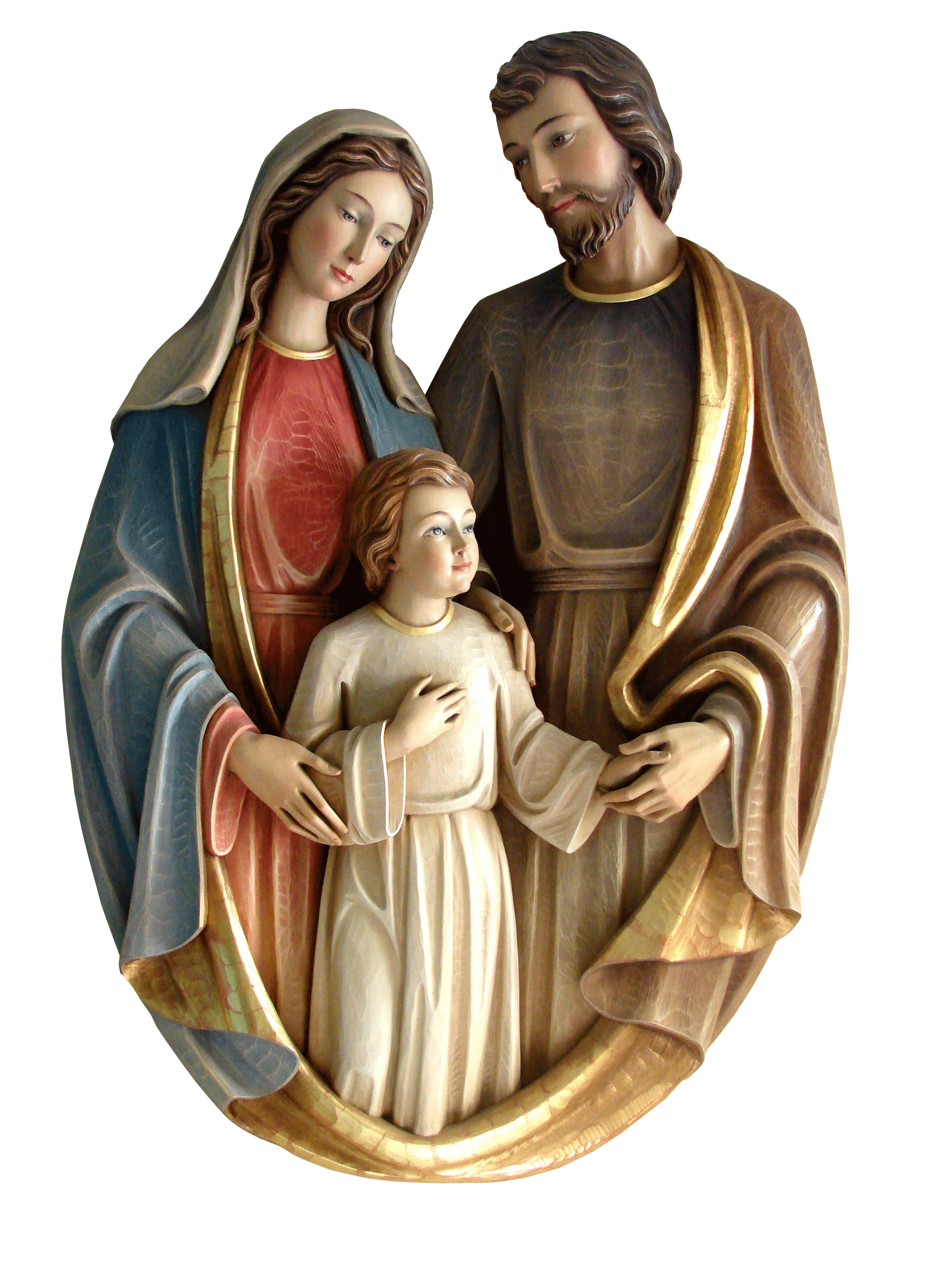
FAMILY LIFE THROUGH THE EYES OF MARY & JOSEPH by Fr. Nelson Lobo OFM Cap

 WONDERING GURU

The “Holy Family,” Normal? | Soulful Muse

Genesis 15: 1-6, 21: 1-3; Psalm 105 1-9; Hebrews 11:8,11-12,17-19; Luke 2: 22-40

Alternative Readings: Sirach 3: 2-6, 12-14; Colossians 3: 12-21

Introduction: If you were going to make a list of the great loving couples of history, who would be on your list? Romeo & Juliet? Anthony & Cleopatra? Mary & Joseph would probably not be on your list, for when we think of them we don’t normally think of them in that way because the spotlight is on Jesus, where it should be. But I think that if we examine the love of Mary & Joseph, we would realize it was a love that stands the test of time. The love they had for each other, coupled with the love they had for God, culminates in one of the greatest love stories ever told.

Reflection: God, as a Father, created a human family of sons and daughters in His own image and likeness, to rule over His Creation. His plan was to have a human family, filled with the fullness of His Spirit, rule on earth as He did in heaven. When Adam and Eve sinned, they became separated from God. This naturally affected their descendants as well.

God created the human family to reflect and demonstrate the perfect relationship that existed in the Holy Trinity. The family was to be a place of intimacy, unity, love, and understanding.  It was to be the place of total trust and obedience, of absolute safety and security. This, unfortunately, is not the case in many families today because of the effects of sin. Instead of experiencing love, peace and joy and enjoying the protection of the family the most vulnerable people are experiencing physical, sexual and emotional abuse.

Many problems facing the world today result from a break-up in family relationships. This is mostly because parents have failed in their spiritual roles. The family should be the place where a child is taught the Word of God and grows up to lead a Christ like life (Prov 22:6; Deut 28:43). Parents have a responsibility to teach their children the Word of God. The Scriptures when read, taught or studied, and obeyed just like Mary & Joseph will transform lives to such an extent that families will enjoy a loving, intimate, forgiving and understanding relationship. Let’s reflect on the life of Mary & Joseph.

  1. FAMILY LIFE THROUGH THE EYES OF MARY (Luke 1:26-38)

Who was Mary? The evidence about Mary points to a humble, godly Jewish upbringing. Mary’s father, apparently, was a descendant of the great King David. She was the cousin to Elizabeth. Perhaps of the tribe of Levi, perhaps a descendant of David since her mother was from Bethlehem. Parents were Joachim of Nazareth and Anna of Bethlehem. Sister was Salome, wife of Zebedee, mother of James and John.

What was Her Character?  Woman of Faith, spiritual, obedient, willing servant. One who had an attitude of Praise.

What was Her Assignment? To give birth to and be the mother of God’s Son.

Mary’s first impressions as a child probably centered on devotion to God and to God’s Word. Gabriel makes it clear that she was chosen by God. As Mary listened to the angel, she must have wrestled with the consequences that would come in her life if she accepted God’s call. As she listens to the angel, Mary says, “I am the Lord’s servant. May it be to me as you have said.” (Luke 1:38) Within Mary’s decision to be fully submissive to the call of God was her willingness, if need be, to suffer ridicule and contempt and loneliness.

  1. FAMILY LIFE THROUGH THE EYES OF JOSEPH (Luke 1:26-38)

Who was Joseph? Tradition says that Joseph was an older man, a taxpayer (Lk 2:1-5), common man, carpenter – probably good with details.

What was His Character? Sexually Pure (Mt. 1:18), Man of Integrity (Mt. 1:19). Man of Faith; Sensitive (Mt. 1:19), Level-headed (Mt. 1:20) – thought about and reflected on situations rather than simply reacting, Spiritual (Mt. 1:20, 2:13) – he is in touch with his God, Obedient (Mt. 1:24,25; 2:13,14) willing servant – willing to obey, not close-minded to something that had never been done before.

What was His Assignment? He was chosen by God to be the earthly father to Jesus. He was the man God chose to raise His son. He was content to be a role player and not the star attraction.

Notice what Mary and Joseph did. At every curve in their life they chose to trust God. They chose to express faith in God. They chose to do the right thing, the ethical thing of following the law, no matter how difficult it might be. They chose to trust God for guidance and provision. Joseph and Mary chose to express their faith by obeying God.

CONCLUSION - Have there been any unexpected curves in your life lately? Is there tension and stress because of these unexpected curves? Mary and Joseph knew about curves in the road. In fact, the Christmas story is a story with unexpected events and curves in the road. The whole story involving these two individuals is a story of trust. Joseph had to trust Mary. Mary had to trust angel Gabriel. Joseph had to trust God. Both Mary and Joseph had to say to God, “I am your servant. Whatever it costs, wherever it takes me, I will do it.”

God continues to look for women and men like Mary and Joseph. People who will pursue obedience, whatever the cost. People who will trust God – even though the outcome seems unsure. God raises up people for his purposes. And God is looking for people humble enough to give him all the glory.


“The future of the Church is the family. When families demonstrate God’s character, His compassion and love in their lives, these will be reflected in the Church. The spiritual growth of families affects the Church in the same way the spiritual growth of the Church affects the families that make up the Church”.

👉  31st December 2023

Wednesday, 20 December 2023

When God says NO to your Plans by Fr. Nelson Lobo OFM Cap


WONDERING GURU

2 Samuel 7:1-5, 8B-12, 14A, 16; Romans 16:25-27; Luke 1:26-38


David wanted to build a brand spanking new house for God, and all of a sudden God says, No.

·       What exactly was wrong with David’s building a house for God?

·       Why would God forbid this man after His own heart?

·       What can we learn from this experience of David?

The first thing is that it was…

I. Forbidden but not WRONG-God had not had a temple at any point from the time he delivered the Israelites from slavery in Egypt until this time. God was not saying that the idea of a temple was wrong. He was saying that the timing was not right. David was not allowed to build the temple because he had shed blood (1 Chr 22:8). God didn’t totally disapprove though. There were two things that he approved of. The first was the SPIRIT in which the offer was made. God appreciated the motive of David’s heart.  Most of the time we see kings turn their back on God when they get to positions of power. They look at all the wonderful things that they have done and swell up with pride. This was not the case with David. The second was the OBJECT of David’s desire. God didn’t say that the temple was a bad idea. He only said that David wouldn’t build it.

II. Forbidden with GOOD REASON.

A. Forbidden because God’s PRESENCE was not CONFINED to a location. The ark of the Lord had been in a tent since Moses put it there during the Exodus. The nation of Israel had been unsettled up to this point and the ark of the Lord in a tent symbolized that situation. God’s presence could be mobile. The presence of God could go with the people. The fact that the ark of the Lord was in a tent meant that it was mobile. God’s presence was with his people. It wasn’t in a fixed location. The temple of God is within his people. Our hearts are the temple of God. God wasn’t saying though that the temple was a bad idea.

B. Forbidden because of The ABSENCE of divine DIRECTION. God didn’t ask David to build the temple. God hadn’t commanded that a house. It was human idea not divine. We have to wait for God’s direction.

C. Forbidden because The TIME still was not RIGHT. Israel had yet to fully settle the land. There were still wars going on with the neighbours. It wasn’t the right time to put resources into building a temple for the Lord. The people were not yet safe from all the enemies that lived nearby.

D. Forbidden because David was not the right man for the job. David had fought off the enemies of Israel, and his hands were bloody as a result. The Lord wanted someone who wasn’t warlike to build his temple. The Lord wanted someone to build who was peaceful. Solomon is given most of the credit for building the temple, but it was David who drew up the plans and gathered the material. David did play a significant role in the temple building, but he did not get to build it.

III. Forbidden for a LARGER PURPOSE. God’s purpose was larger than David could have imagined. God’s purpose involved something larger. The Messiah came through the descendants of David. Jesus is referred to as the “Son of David.” God’s greater purpose in the plan for David’s life involved the Savior of the world. The temple that Solomon built is long gone. Jesus is still on the throne. David’s plan was good and noble, but God’s plan was bigger and better.

Conclusion: God was most gracious in the manner in which he forbade David from building the temple.  God showed David regard. He let David know that he was held in high esteem. God reminded David of what he had already done.  David had done great things. He had brought stability to the land of Israel.  God promised David an enduring dynasty. The Lord said, “And your house and your kingdom shall be made sure forever ... Your throne shall be established forever.”

God’s agenda is not building houses, but homes. God’s agenda is not building structures, but people. God’s agenda is not filling institutions, but filling spirits. We invest ourselves in big dreams and plans, the noble works of our imaginations; but God invests Himself in lives, hearts and souls. God builds not houses, but homes. God’s agenda is people, making a home for Himself among people. God’s agenda is lifting up the fallen, binding up the broken-hearted, healing the wounded, forgiving flawed. God is always about: building lives. Making homes, not just houses; making people, not monuments.


👉4th Sunday of Advent Dec 24 2023, Year B


Baptism of the Lord by Fr Nelson Lobo OFM Cap

  WONDERING GURU Isaiah 42: 1-4, 6-7 or (40: 1-5, 9-11);  Psalm 104: 1b-2, 3-4, 24-30 Titus 2: 11-14; 3: 4-7;  Luke 3: 15-16, 21-22   ...