Saturday, 26 August 2023

WHO IS JESUS TO YOU? Fr Nelson Lobo OFM Cap


WONDERING GURU

Isaiah 22:19-23; Rom 11:33-36; Mt 16:13-20


Although Jesus Christ did not come to please people like the politicians; we find Jesus in Mat 16:13 taking a poll amongst His disciples. At this point in Jesus ministry, the news of His preaching and miracles had spread all around. The religious leaders had also heard about Jesus Christ and they didn’t like what they had heard. He was a threat to their power and prestige amongst the Jews. The Pharisees had accused Jesus of getting His power from Satan. He had been rejected by His home town. So in the midst of growing opposition and surrounded by crowds of people who liked Him but did not understand Him, He took his disciples and left Israel. He went north out of Israel into Gentile territory, to a place called Caesarea Philippi. Jesus knew that it would not be long before He would be crucified. He knew that He would be leaving this earth. This was the time that Jesus was going to find out where the disciples stood. Jesus asked His disciples 2 questions. The first question is in verse 13, "Who do people say the Son of Man is?" Jesus wanted His disciples to acknowledge what other people were saying. So they gave him the four most popular answers about who Jesus is. "Some say John the Baptist (that was Herod’s answer); others say Elijah (that was very popular because the Jews expected Elijah to return); and still others, Jeremiah (he was the greatest of the later prophets) or one of the prophets (that is, he was a spokesman for God)."

Jesus then asked His disciples a more important question. "But what about you?" he asked. "Who do you say I am?". Peter¡¦s answer is very specific. Simon Peter answered, You are the Christ, the Son of the living God."  This is a very important statement for us to catch. Peter did not figure Jesus identity out on his own. This was revealed to him by God.

The church is made up of men and women who confess this truth. Jesus Christ is the Son of the living God. Things haven’t changed much. Some people today still think Jesus was just a prophet – non-Christian religions for example recognize that He was a good teacher and a fine religious leader, but surely not the only begotten Son of God. Some think He’s just a myth, a figment of our imagination. He’s a crutch for weak-minded people.

Others think that He was a great historical figure, certainly a good man, a good teacher, a man of character and integrity but not God. He can be any number of things to an endless number of people, and it is easy to become appalled at what many think about Jesus. He was hated and ridiculed then and He is hated and ridiculed today.  People always have and always will be confused about who Jesus is.

The name Christ is the official title of our Lord, occurring 514 times in the New Testament. It means that He was anointed or consecrated to His great redemptive work as Prophet, Priest, and King of his people.  To Abraham He was the ram. To Israel He was the lamb. To Ruth He was a Redeemer. To Nehemiah He was a Master Builder. To David He was the Tender Shepherd. To Solomon He is the Wise and All-Knowing God. To Amos He was the Burden Bearer. To Malachi He was the Sun of Righteousness with healing in His wings. To Mark He was the Suffering Servant. To John He was the Light of the world. To Paul He was a Wonderful Savior.

The Bible says that Jesus is… our Lord, our Comforter, our Advisor, our Mediator, our Strength, our Inspiration, our Protector, our Provider, our Shepherd, our Master·

If you really want to know who Jesus is, then you need to get into the book that identifies who He is! We’ve considered who other people say Jesus is, and more importantly we’ve considered who the Bible says Jesus is, but now let’s consider the third and most important question of them all.


WHO DO YOU SAY HE IS?

· He began His ministry by being hungry, yet He is the Bread of Life.

· Jesus ended His earthly ministry by being thirsty, yet He is the Living Water.

· Jesus was weary, yet He is our rest.

· Jesus paid tribute, yet He is the King.

· Jesus was accused of having a demon, yet He cast out demons.

· Jesus wept, yet He wipes away our tears. Jesus was sold for thirty pieces of silver, yet He redeemed the world.

· Jesus was brought as a lamb to the slaughter, yet He is the Good Shepherd.

· Jesus died, yet by His death He destroyed the power of death.

Conclusion: A lot of people name the name of Jesus, but what does that really mean for you? The devil names the name of Jesus, but what does that mean? The devil is not an atheist. He knows that Jesus is real. He knows there is a God, but operates as if there were no God. He believes in God, but he doesn’t love Him.  He acknowledges God, but he doesn’t glorify Him. Jesus wants to be real in your life but it’s up to you whether He will be or not. You see, Jesus already knows who you think He is – He is asking you this question today so you might recognize whether He has the pre-eminence in your life like He deserves! Who is Jesus to you? Is He your magic genie or is He the Christ, the Son of the living God in your life? Is He your sugar daddy in the sky? Or is He God, the Lord and Master of your life?

👉21st Sunday in Ordinary Time; 27th August 2023

Thursday, 17 August 2023

My House Shall be called a House of Prayer for all Nations by Fr Nelson Lobo OFM Cap

 WONDERING GURU

Isaiah 56:1, 6-7; Rom 11:13-15, 29-32; Mt 15:21-28


Fr Nelson Lobo OFM Cap


FIRST READING: R. Scott Richards wrote in his book, “Myths the World Taught Me” that every one of us starts life as a little savage, selfish and self-centered. We want what we want when we want it. Deny us these once, and we seethe with rage which would be murderous were we not so helpless. We are, in fact, dirty; no morals, no knowledge, no skills; children born delinquent. And if permitted to continue every one of us would grow up a criminal - a thief, a swindler, or a rapist. That’s what we all are except that God, by his grace and mercy, intervenes in our life by the power of His word for help and salvation, for positive change.

The first reading tells us “for my house will be called a house of prayer for all nations.” It’s part of the joy of the Gospel. None of us are excluded – not for our past, not for our family history, not because of our caste or creed or culture. God’s promise is that we’re all welcome, that we all belong, by virtue of our faith. Sinners all, made righteous in Christ’s blood; and in this gracious righteousness we look at others in new ways. We see them as we are, another sinner for whom Christ died, another one lost who needs God’s grace, a potential brother or sister in God’s house forever.

God’s plan is to gather still more besides us whom he already has gathered. And the joy of it is that he would use you; once lost but now found and fashioned into tools of the Spirit to gather even more – people of every walk-in life, peoples of every nation in the world – He would use to gather them all to the joys of knowing Christ Jesus and the eternal blessings that spill forth from His Church, His House of prayer.

SECOND READING: The church at Rome had some inter-cultural and inter-racial difficulties between the Jews and the Gentiles.  Some of the Jews looked down on the Gentiles because their ancestors had not been part of covenant God had with His people in the Old Testament. So, a major part of the Letter to Rome focused on this conflict. In the first few chapters Paul addresses to the Jews saying they sinned just like the Gentiles had. And they needed God’s grace and mercy just as much as the Gentiles did.  Paul addresses a ticklish question that some might have asked: “Did God reject his people?” “Did they stumble so as to fall beyond recovery?” Paul says – NO! God hasn’t rejected His people. No – they haven’t stumbled so far that they can’t be restored. God Never Forgets His People! That’s the MAIN MESSAGE of this chapter.

 GOSPEL: An unnamed Syro-phoenican woman/mother came to Jesus pleading for help.  Her situation was quite complicated and delicate. She had a problem-her daughter was demon possessed. She had great pain - she was grievously vexed - both mother and daughter. She was dealing with a power beyond herself - it was supernatural, suppressive, and satanic. But she has a plan. She heard about the power of Jesus.  She is going to meet Jesus no matter what. In her desire for healing her daughter she has a simple cry - to catch the Lord’s attention and a sincere cry from the heart.  But she encounters unexpected hurdles:

(a) The silence of the Saviour - her test - do you really know who I am?

(b) The selfishness of the disciples v. 23 "send her away, for she crieth after us"

(c) The sinfulness of her past v. 24 "the lost sheep of the house of Israel".  Paul says Ephesians 2 v. 12, she was without hope, without promise, and without God in the world

Inspite of her hurdles she decided not to give up.  Continued to pray and plead. Her pleading was short, humble, fervent, desperate, rational, respectful, worshipful, persevering, determined, and full of faith and humility.  This impressed the Lord.  The Lord answered her prayer. Her request was granted. Her daughter was healed.

CONCLUSION: Prayer is the umbilical cord of intimacy with the Father. Prayer is the lifeblood of the believer. Robert Murray McCheyne once said, "What a man is on his knees before God, that he is, and nothing more." The father of the Protestant Reformation, Martin Luther, wrote, "If I should neglect prayer but a single day, I should lose a great deal of the fire of faith."  God invites all to his house to pray and to worship.  Let’s forget our differences and our backgrounds and pray and worship the Lord as one people of faith. Amen! 

👉20th Sunday in Ordinary Time, 20th August 2023

Thursday, 10 August 2023

Peace in times of Fear & Depression by Fr Nelson Lobo OFM Cap

 WONDERING GURU


1 Kings 19:9A, 11-13A: Romans 9:1-5; Matthew 14:22-33

Fr Nelson Lobo OFM Cap


FIRST READING:   Depression is very real part of life for many people. It is a very real problem. Depression is marked by a sense of being pressed down, weighed down, or burdened, which affects a person physically, mentally, spiritually, and relationally.  Many Biblical characters faced DEPRESSION such as Moses, Elijah, Paul, Psalmist and even Jesus. John 12:27 "Now My soul has become troubled; and what shall I say, ’Father, save Me from this hour’?

God gives us a case study in clinical depression in todays first reading. From this text we find that Elijah experienced many of the classic symptoms…

Fear - “Elijah was afraid and ran for his life….” (1 Kings 19:3). Suicidal tendencies – “I have had enough, LORD, Take my life; I am no better than my ancestors.’ (1 Kings 19:4).  Excessive tiredness – “Then he lay down under the tree and fell asleep…” (1 Kings 19:5).  Feelings of rejection – “The Israelites have rejected your covenant, broken down your altars, and put your prophets to death with the sword. I am the only one left, and now they are trying to kill me too.” (1 Kings 19:10).

What does this tell us? It tells us that even God’s most dynamic servants can suffer from depression. It’s not necessarily a mark of a lack of faith.  Elijah was THE man of God in his day. And now he’s so far down in the depths of despair. But that’s not where God left him. God didn’t say: “well sorry Elijah – you have a chemical imbalance in your brain– so I can’t help you!” God recognized that Elijah’s depression was not an imaginary problem. Elijah’s depression was real. And God did not say – “get a hold of yourself Elijah. This is a SINFUL attitude … where’s your faith man???”  God didn’t treat Elijah roughly. Infact God understood his depression and provided for his physical needs. In answer to Elijah’s prayer to die, God just lets him sleep. Then God sends him down to the desert in the South for 40 days and nights.  God sent him to a place of worship – God sent him to Mt. Horeb, the Mt. of God (where the Law given to Moses). Church is one of the best places to deal with Depression. The Church is a place where we listen to each other and help one another. “Bear one another’s burdens, and so fulfil the law of Christ.” (Gal 6:2)

 SECOND READING: One very unique thing about Paul’s anguish over the lost and rebellious state of his Jewish brethren was his impossible desire to be cut off from Christ for the sake of his brothers. So burdened and anguished over the Jews rejection of Christ and their being on their way to Hell is Paul that he makes it clear that he wishes he could trade his salvation and very life for the salvation of the Jews that he would. What Paul says finds a parallel in Exodus 32:32. When Moses came down from the mountain after receiving the 10 commandments, he found the people dancing around the golden calf and worshiping it as their god. In response to such Moses said “Lord, if it be possible, blot this sin from their lives, but if not, blot me out of your book” The tragic mistake, the mistake which we see Paul deeply grieved over, is that the Jews have put their confidence in these blessings for their salvation- rather than in Jesus Christ to whom these things point.

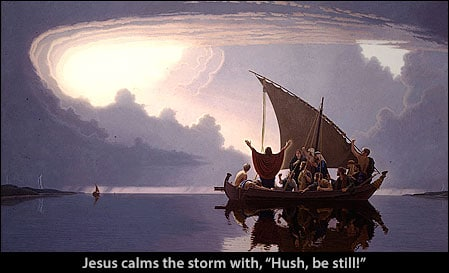
 GOSPEL: The Gospel says “when evening came…” and it refers to the “fourth watch of the night “. This gives us a time frame to work with. Feeding 5,000 people took all day! By evening disciples were dispatched, crowd dismissed, Jesus begins climbing slope of a mountain to find a place to pray. Storm arises while they are in “the middle of the sea” [Mark 6.47] – i.e., about four miles from shore. How long does it take to row four miles? Why did Jesus wait until the fourth watch of the night (after 3:00 am) to respond to their prayers? Why didn’t he go to them immediately? Surely, they were praying. He knew that they were in the storm.

Apparently, Jesus’ delay in coming to them was intentional. Why does the Lord often delay in answering prayer? The Lord had a lesson he wanted to teach them. But they were not ready. They had abandoned hope. Their faith had crashed. When they saw something coming toward them on the water, they had by then given up on the possibility that Christ would save them. But Jesus had sent them into the storm in the first place.

Do not feel abandoned when your prayers seem unanswered. Jesus’ prayer that the cup of suffering be removed was not answered. Paul’s prayer that his thorn in the flesh be eased was not answered. Remember their words, “Not my will but your’s be done” and “My grace is sufficient.” Unanswered or delayed prayer are for a reason and we must discover that reason.

Very often you can expect Jesus to come to your rescue only after all other means of rescue are gone. The Fourth Watch represents those times of hopelessness and helplessness we all feel from time to time. The Disciples on the storm-ravaged Sea that night, by the fourth watch, were exhausted. They were physically exhausted. Their prayers were exhausted. Surely, they had fervently prayed throughout their ordeal. Their expectations were exhausted. Certainly, they had expected a prompter response to their emergency. Their hope was exhausted. If Christ was coming, he would have come before now. Their faith was exhausted. When Christ finally appeared, they thought he was a ghost, a hallucination.

We all face our Fourth Watches. These are times of despair when Jesus often comes to us.  So in your problems and depressions, fears and anxieties don’t give up. Continue trusting in the Lord for He is the Lord of heaven and earth. Amen !

19th Sunday in ordinary time, 13 August 2023


Wednesday, 26 July 2023

Seeking Wisdom, Surrendering to God, Finding the Treasure by Fr Nelson Lobo OFM Cap


WONDERING GURU

👉17th Sunday in Ordinary Time, Psalter Week -1, 30th July 2023


Fr Nelson Lobo OFM Cap

 1st Reading: (1Kings 3:5, 7-12)- Solomon could have asked for riches, but rather he asked for the ability to fulfil his God given calling - to be a fair and just ruler in Israel. Solomon wanted the things of God ahead of any riches and honour for himself. What was most important for him at that time was to be able to walk God’s ways.  So, he chose a discerning heart to be able to be a good governor of God’s people.

WHY Solomon made such a good and wise choice in response to God’s question? I can think of two reasons:

1. His Father’s influence-The first reason was the good influence of David his father. We read in 1 Kings 2:1-3 of David giving Solomon a solemn charge “I am about to go the way of all earth…So be strong, show yourself a man and observe what the Lord your God requires: Walk in his ways and keep his decrees and commands, his laws and his requirements …” (2 Kings 2: 2-3) Parents can have a real influence on their children – for good and for evil.

2. Solomon was committed to God’s will for him. He actually decided for himself that he would follow the ways of God. We cannot make a commitment to God for anyone else except ourselves. Parents can pray for their children and advise them but it is still THEIR decision whether or not they commit themselves to following God.  As they say: “You can take a horse to water but you can’t make it drink.” David wanted his son to follow God’s ways, but Solomon still had to decide to do so for himself.

2nd Reading: (Romans 8:28-30)- A young boy traveling by airplane to visit his grandparents sat beside a man who happened to be a seminary professor. The boy was reading a Sunday school take-home paper when the professor thought he would have some fun with the lad. "Young man," said the professor, "If you can tell me something God can do, I"ll give you a big, shiny apple." The boy thought for a moment and then replied, "Mister, if you can tell me something God can’t do, I"ll give you a whole barrel of apples!"

Even though many Christians can quote Romans 8:28, few of them fully realize the GREATER GOOD spoken about in the text. Only when we are able to completely surrender our rights, problems and perspectives to the Lord can we fully appropriate the greater working of God through our disappointments, hurt and difficulties. So be willing to roll all of your cares, fears and feelings of anger on to the Lord. (I Pet. 5:7). Learn to lovingly accept whatever God allows to come into your life since He is able to deliver you from any and all problems.

Gospel: (Mt 13: 44-52) The pearl is the oyster’s answer to that which wounded it. The pearl owes its existence to the oyster’s willingness to cover that which had cut it. Our part was the cutting, and God’s part was the covering.

A new convert to Christ says: "I found Christ." Yes, it may seem like we did find Christ. But it is Christ who offers the Treasurer and the Pearl to the people traveling along life's highway. The Truth is the sinner cannot "find Christ" for he is blind and stubborn. "There is no one who is righteous, not even one; there is no one who has understanding, there is no one who seeks God." (Rom 3:10)

Common interpretation: The Pearl and the treasure represents Jesus Christ, and the man is a seeker who gives all he has to obtain salvation. He turned his back on all he had to achieve heaven.  This involves single minded purpose and total commitment and dedication on the part of the seeker to find the pearl or the treasure that is Jesus Christ. True discipleship asks us to give up things and put on Christ, but that is sanctification, not salvation.

New Interpretation:  People aren’t seeking Jesus, but rather, Jesus is seeking them. This is the work of the Holy Spirit to call, to convict, to convince. The merchant man is Christ, and we, the church is that pearl which He purchases at great cost. He gave His all on calvary. He seeks and saves that which was lost. The pearl is a perfect picture of the church. It is formed miraculously, and for the purpose of being presented back to its maker. Its creator is the owner, just as the church was founded by Christ and is His bride! You are His pearl of great price, buried in a sea of sinfulness, lost, just a grain of sand, and He has poured out Himself upon you until you have become His godly pearl.


Thursday, 20 July 2023

WHY PARABLES? by Fr Nelson Lobo OFM Cap


WONDERING GURU

WHY DARNEL? WHY MUSTARD SEED? WHY LEAVEN?

 Wis 12:13, 16-19; Rom 8: 26-27; Mt. 13: 24-43


 Why Jesus used parables in his teaching & preaching?

Parables were stories that Jesus told to describe spiritual truths & realities people would have never seen or would never see. No one had ever seen the “Kingdom of God” Jesus was describing, So, He told parables to help people visualize what it was going to be like.

Why the Darnel?

Darnel is a weed that looks like the real thing, it has some of the characteristic of the real thing, but it is not the real thing. This tare like the wheat has been planted by the enemy. It grows in the same field, it receives the same water, the same sunshine, but it never produces any fruit. The tare being sown by Satan many times will be the cause of much of the trouble in the church. We live in a day and time when everyone around us looks like Christians. People have more religion today than ever before, yet they have never met Jesus Christ. This tare speaks of the people who go to church all the time. They do all the things a Christian is supposed to do, but they have never established a relationship with Jesus. The tare is among the wheat, but not of the wheat. Judas was among them but not of them. He went along through time, looking like a disciple, but he was never a true disciple. You may look like a Christian, you may act like a Christian, but unless Jesus resides on the inside of you, you can never be a true Christian, you have been deceived by satan and you are a counterfeit Christian.

Why a mustard seed?

Why choose the mustard seed to represent the Kingdom? Why choose something so common and so ordinary to paint a picture of the powerful and majestic Kingdom? Jesus chose the mustard seed for His parable because of its size. He used it because even something as small as a mustard seed had great power within it. Likewise, the Kingdom of God - the church – has the power to grow & to do things that no human institution can emulate (1 Cor 3:11). 

Why did Jesus choose the mustard seed to represent His Kingdom?

Because God is always consistent: He "chose the foolish things of the world to shame the wise; God chose the weak things of the world to shame the strong. He chose the lowly things and the despised things— of this world and the things that are not— to nullify the things that are, so that no one may boast before him." (1 Cor 1:27-29). Jesus chose the mustard seed, because of the humility it represented, and because of the Life giving power it had within it.

Why compare the Kingdom of God to a Tree?

The believer is often compared to a tree in the scriptures. Ps 1:1-6 Blessed is the man that does not walk in the counsel of the ungodly…he shall be like a tree planted by the rivers of water, that bringeth forth his fruit in his season.  Jer 17:7-8 Blessed is the man that trusts in the Lord…For he shall be as a tree planted by the waters, and that spreads out her roots by the river…. Is 61:1-3 The Spirit of the Lord is upon me…that they might be called trees of righteousness, the planting of the LORD. Just like we tell kids if they swallow water melon seeds, a tree will grow inside them so also a tree should grow within us. A spiritual “Tree of Life” should grow in us which represents the kingdom of God in our life.

What is the purpose of a tree in our life?  

Prov 11:30 says “The fruit of the righteous is a tree of life; and he that wins souls is wise”. A tree bears fruit - God expects spiritual fruit in the life of a believer.  Gal 5:22-23; Eph 5:9-10; Mt 7:20 ...by their fruits you shall know them. This tree restores to man the eternal life that was lost in the Garden of Eden.

Why Leaven?

Jesus took his parable from something that he had often seen his mother do. In Jewish language leaven is almost always connected with an evil influence. (Mt 16:6; 1Cor 5:6-8; Gal 5:9). So, Jesus anticipated a certain shock in hearing the kingdom of God compared to leaven.  The shock would arouse interest in what Jesus said.  The whole point of the parable lies in one thing-the transforming power of the leaven. 

What do we learn from these parables?

·       There is always a hostile power in the world seeking and waiting to destroy the good seed.

·       It’s very difficult to distinguish between those who are in the kingdom and those who are not. Some appear to be good but they are bad. Some appear to be bad but they are good.

·       We learn not to be quick with our judgements. Judgement had to wait until the harvest time.

·       Size doesn’t matter to God-We will never be too small for God. God is concerned with what we are becoming.

·       The Christian life is like a tree that bears life giving fruit (Mt 7:17-20)

·       God promises we will partake of the Tree of Life.  (Rev 2:7)

·       Finally, Christianity is a religion of hope. It has the power to transform lives and societies.

 ðŸ‘‰16th Sunday in ordinary Time, 23rd July 2023

Thursday, 13 July 2023

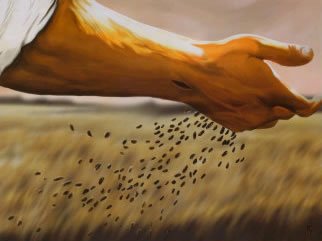
The Parable of The Sower, The Seed and The Soils by Fr Nelson Lobo OFM Cap

 WONDERING GURU

Isaiah 55:10-11; Romans 8: 18-23; Mt. 13:1-9

The Sower and the Seed | Being Church in the 21st Century


Introduction: The first recorded parable of Jesus most probably was “The Parable of the Sower and the seed”. It is a foundation parable of the Kingdom of God. Interpretations of most of Jesus’ parables are not recorded, but in this case, we have it spelt out clearly so we don’t need to speculate. The aim of the parables was to draw out from the crowds the few who would grasp what Jesus was driving at. These fascinating parables would be the window of understanding, the filter, to separate those who believed in Jesus and those who rejected Him. The classic definition of a parable is “an earthly story with a heavenly meaning.” It tells us in familiar human terms something about God’s reign in human life and His terms for the salvation of humankind. Let’s consider the constituents of the parable.

WHO IS THE SOWER?

There can be no doubt that it’s Jesus! He was sowing seed as He travelled the country preaching the good news of the Kingdom. He was fulfilling what had been prophesied by Isaiah: “The Spirit of the Lord is on me, because he has anointed me to preach good news to the poor …”. He was clearing up the misunderstandings of God’s message over the centuries. His Kingdom was coming in with seeds, not swords; with God’s revelation of His mysteries, not human wisdom; with changed lives through redemption, not Satan’s domination. The Sower symbolizes not only Jesus Christ, but also all who are engaged in preaching the Gospel. In every age God has called men and women to be His messengers.  Paul tells the believers in Corinth: “For we are God’s fellow workers” (1 Cor 3:9).

WHAT IS THE SEED?

Jesus Himself gives the key to understanding how the Kingdom of God is to be found: The seed is the word of God” (Lk 8:11). The Word of God is a life-giving seed waiting to be implanted in the receiving hearts. It has the power to transform human hearts. Paul said, “It is the power of God for salvation” (Rom 1:16).

WHAT ARE THE SOILS?

It’s obvious that the soil is the human heart. Jesus describes one sowing but four different soils which explains why people respond as they do. Neither the Sower nor the seed can change the soil. The same Sower and seed produced no crop, some crop, or much crop, depending on the soil. Jesus began His explanation of the Parable by describing three categories of “bad-soil” hearers. There’s:

Seed along the Path: Fields in Palestine were small and separated from one another by paths where the soil was beaten flat under human feet and the summer sun. As the sower walked down the field, some landed on this impenetrable soil and “birds came and ate it up” – in other words “the evil one comes and snatches away what was sown.” These are people who clearly say “NO” to the Gospel. Sadly, the Word of God enters in their one ear and passes through the other ear. This can happen to any professing Christians.

Seed on the Rock: There was a thin layer of soil on the rock, allowing seeds to germinate but the plants could never get good roots. When the sun beat down, they withered and died. Jesus said it portrayed “the man who hears the word … with joy. But since he has no root, he lasts only a short time.” It’s possible to make an enthusiastic initial response but it doesn’t last. It’s all emotion. The cost of being a Christian hasn’t been counted. These are people who respond uncertainly to the seed of the Word – it’s “YES AND NO” – they want to keep a foot in both camps, but it does not work that way.

Seed among Thorns: Jesus refers to the soil of the heart where a person “hears the word but worries of this life and the deceitfulness of wealth choke it, making it unfruitful.” This person answers to the call of God by saying “YES BUT”. Their life becomes clogged with materialism and worldliness.

Good-Soil: The good-soil person, “is the man/woman who hears the word and understands it”. The reply to the call of the Word is an unequivocal “YES”. Jesus said that the qualification for good-soil is that it “produces a crop”. “Fruit” says Jesus, is “showing yourself to be my disciples” (Jn 15:8). It is “all goodness, righteousness and truth … what pleases the Lord” (Eph 5:9,10). It’s the “fruit of the Spirit … love, joy, peace, patience, kindness, goodness, faithfulness, gentleness and self-control” (Gal 5:22). Perseverance is the hallmark of the truly converted person and will “produce a crop, yielding a hundred, sixty or thirty times what was sown.” It results in the further production of seed - the Word of God being made available to another generation who need to hear the Gospel.

Jesus, as ever, ends the Parable on a note of challenge, “He who has ears to hear, let him hear.” The Master Sower Himself is asking us: “What kind of hearer are you?” Is our hearing impaired by the secular noise level of our busy lives? One day, God is going to hold us accountable for our spiritual productivity.


Wednesday, 5 July 2023

Come To Me and Rest by Fr Nelson Lobo OFM Cap


WONDERING GURU


STORY: One of the classic films of 1987 was The Mission. In it, a soldier, Captain Mendoza, kills his brother in a feud over a woman they both love. Afterward, desperately depressed and consumed by remorse, he feels that the only way to get rid of his burden of guilt and sin is to perform some sort of penance. So, he ties a huge net to his back, fills it with boulders, and sets himself to climb a high mountain. In the company of a priest and some others, he travels over rocks, swamps and thick brush, across rivers and through forests. You see him, cut, bruised and bleeding, a broken figure, crawling up the mountainside, the huge weight dragging behind him. From time to time, the others in the group urge him to let go of the burden. "You don’t have to carry it anymore," they say. But he cannot leave it. Eventually, reaching the top of the mountain, he collapses, exhausted. And then a little boy comes up to him and cuts the net from him. As the net and rocks cascade down the mountainside, Mendoza is filled with a feeling of total release; his burden is gone and he feels he has been forgiven.

When we look around at the people who attend the church, what do we see? We see people, dressed in fine clothes and wonderful make up. But if you talk to them personally, we see hurting people in need of comfort; troubled people in need of peace; sick people in need of healing. The sad fact is that we all have something that puts us under enormous pressure and stress from time to time. Weariness is simply a problem that we all face in this life. Job said that, “Man that is born of a woman is of few days and full of trouble” (Job 14:1).

Marshall Hayden wrote an article entitled, "Would Every Non-Hurter Please Stand Up?" He pointed out that people come to church wearing their best clothes & their best smiles. Everybody looks happy, so we assume everything is okay. But he suggested that we need to look beyond the facade & realize that the pews are full of hurting people.

·       There are hurting families whose income is much less than their expenditures.

·       There are hurting children who never receive appreciation or encouragement from their elders.

·       There are wives who constantly suffer from drunkard or narcissistic husbands.

·       There are men and women suffering from cancer, tumour, kidney problems, skin allergies, headaches and backaches who are waiting for a healing miracle.

·       There are couples who have nasty fights and think of divorce.

·       There are some searching for a job and those who lost their jobs.

·       Then there are those of us with lesser hurts, but they look big to us: a boring job, a poor grade, a friend or parent who is indifferent. The lonely, the discouraged, they're all here.

And it is to such people that Jesus is saying, in Matthew 11:28-30, "Come to me, all you who are weary & burdened, & I will give you rest. Take my yoke upon you & learn from me, for I am gentle & humble in heart, & you will find rest for your souls." This is not to say that He will resolve every problem immediately, for Jesus clearly said that we will have trouble in this world. But He can resolve our problems if we trust in Him. In some cases, He may resolve the problem immediately. In other cases, He grants the power to endure the difficulty & triumph over it. 

Bible is full of such stories of hurting people. Why such stories in the Bible? Why did God leave us one tale after another of wounded lives being restored? So, we could be grateful for the past? So, we could look back with amazement at what Jesus did? No! The purpose of these stories is not to tell us what Jesus did. Their purpose is to tell us what Jesus does. "In Romans 15:4 Paul wrote, 'Everything that was written in the past was written to teach us, so that through endurance & the encouragement of the Scriptures we might have hope.' These are not children's stories, or romantic fables for entertainment or information. These are historic moments in which a real God met real pain so we could answer the question, ‘Where is God when I hurt?’

·       How does God react to dashed hopes? Read the story of Jairus.

·       How does God feel about those who are ill? Stand with him at the pool of Bethesda.

·       What is God’s word for the shameful? Watch as his finger draws in the dirt.

·       How does God respond when there are obstacles in your path? Read the resurrection stories of Lazarus and Jesus. I know that there are stones in your path. Stones that trip and stones that trap. Stones that are too big. But have faith. Our God is so big and so mighty that there’s nothing our God cannot do.

The God who spoke still speaks. The God who forgave still forgives. The God who came still comes into our world. He comes to move the stones that we cannot move. As the first reading invites us (Zech 9:9-10) let us not worry too much but rejoice like the daughter of Zion because our Messiah comes to bring us comfort and rest.  But we need to have the spirit of Christ in order to rejoice as the second reading tells us (Rom 8:9, 11-13). Jesus meek and humble of heart hear us. Amen!


 “You only want what you ain’t got.” What ain’t he got? “Peace!” said Harrison Ford: The actor whose movies have grossed over 2 billion dollars

Baptism of the Lord by Fr Nelson Lobo OFM Cap

  WONDERING GURU Isaiah 42: 1-4, 6-7 or (40: 1-5, 9-11);  Psalm 104: 1b-2, 3-4, 24-30 Titus 2: 11-14; 3: 4-7;  Luke 3: 15-16, 21-22   ...